
Many bite problems can be corrected with braces or clear aligners alone. Jaw surgery is usually reserved for adults whose upper and lower jaws are significantly out of balance, a skeletal problem that moving teeth cannot fully fix once growth has finished.
Can Braces Fix a Bad Bite Without Surgery?
For many patients, yes. Crowding, spacing, many overbites and underbites, and a lot of crossbites come from teeth that are tipped or positioned in the wrong place while the jaws themselves are a reasonable size. These are dental problems, and braces or aligners correct them by moving teeth through the bone into better positions.
The question changes when the jaws themselves are the problem. If the lower jaw has grown much farther forward than the upper jaw, or the upper jaw is far too narrow or too short, the teeth may be sitting in reasonable positions on bones that do not line up. Moving teeth can hide some of that mismatch, but there is a limit to how far teeth can safely move before the roots run out of bone or the face looks unbalanced.
The orthognathic surgery page at Mia Orthodontics puts it simply: mild bite issues can often be resolved with braces or aligners alone, while surgery is for severe jaw imbalances. The work of an orthodontic exam is figuring out which side of that line your bite falls on.
How Do Orthodontists Tell a Dental Problem From a Skeletal One?
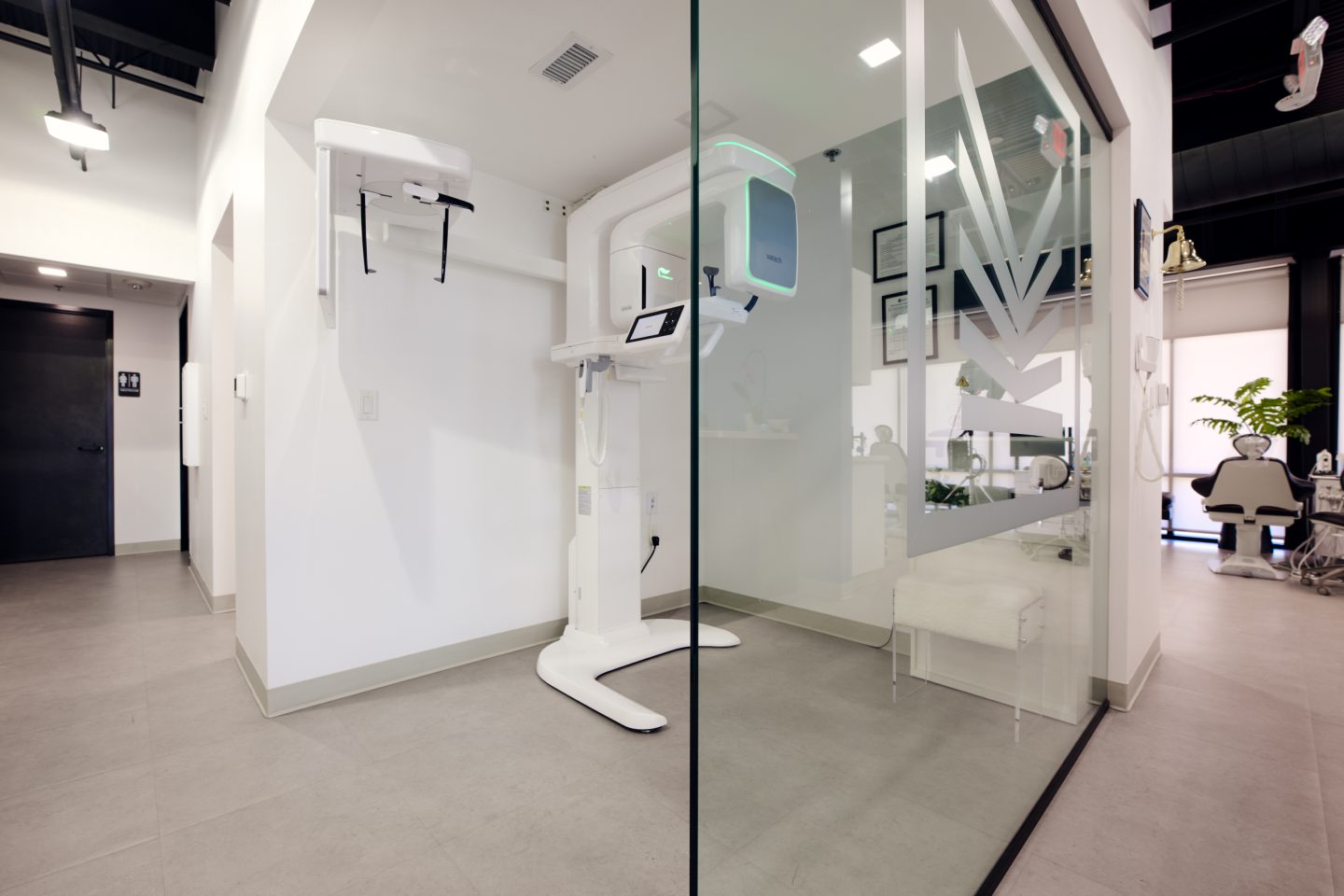
A bite can look severe and still be dental, or look mild and have a skeletal cause, so the answer comes from records rather than a mirror. At Mia Orthodontics, the evaluation uses a 4-in-1 digital 3D X-ray system that combines panoramic, cephalometric and CBCT imaging with model scanning. Those images show the size and position of the jaws, the angle of each tooth and how much bone surrounds the roots.
The practice also uses the RayFace scanner, which captures a 3D model of the face in seconds and combines it with intraoral and CT scans to build a virtual patient. That lets the orthodontist see how the teeth, jaws and soft tissues relate, and share the same data with other specialists involved in a complex case. Learn more about the 3D imaging and scanning technology behind those records.
Orthodontists also look at function. How do the teeth meet when you chew? Does the jaw shift to one side to close? Are there signs of breathing or jaw joint strain? Those findings, combined with the images, show whether a bite problem lives in the teeth, the jaws or both.
Which Bite Problems May Need Jaw Surgery?
According to the practice, conditions that may call for surgery include a severe underbite, overbite or open bite, facial asymmetry, sleep apnea linked to jaw structure, and TMJ disorders related to jaw alignment. In each case, the issue is not just where the teeth sit but where the jawbones sit relative to each other.
Surgery can reposition the upper jaw, the lower jaw or both, restoring balance between them so the teeth can meet properly. Candidates need to be in good health and committed to a plan that combines surgery with orthodontic treatment, because the two are designed to work together. If jaw pain is part of the picture, our post on whether braces or clear aligners can fix TMJ jaw pain covers how bite and joint problems connect.
Even when a bite falls into one of these categories, surgery is not automatic. Many adults who have been told they need jaw surgery turn out to have non-surgical options worth considering first.
What Non-Surgical Options Exist for Adults?
Advances in orthodontic anchorage have widened what can be treated without surgery. Dr. Alireza Hourfar, a board-certified orthodontist, focuses on complex cases such as skeletal open bites, gummy smiles, molar intrusion and adult palatal expansion, using temporary anchorage devices as a non-surgical alternative to jaw surgery whenever that is a realistic option.
| Option | What it can address | Main limitation |
|---|---|---|
| Braces or aligners alone | Dental crowding, spacing and many mild to moderate bite problems | Cannot change the size or position of the jaws |
| Mini-implants (TADs) | Molar intrusion, deep bites from over-erupted molars, gummy smiles, midline and asymmetry corrections | Needs healthy gums and bone; moves teeth, not whole jaws |
| MARPE | A narrow upper jaw and crossbite in older teens and adults | Depends on bone maturity and density |
| Orthognathic surgery | Severe skeletal imbalances between the upper and lower jaws | Requires surgery and a recovery period |
MARPE, or miniscrew-assisted rapid palatal expansion, widens a narrow upper jaw using an expander anchored to the palate with small titanium miniscrews. For many older teens and adults with a crossbite, it offers an alternative to surgically assisted expansion. Mini-implants work in a similar way for other movements, giving the orthodontist a fixed anchor so teeth can be moved up into the bone or shifted as a group. Our post on orthodontic mini-implants explains how they work alongside braces for adults or aligners.
The honest answer is that these tools extend the range of non-surgical treatment but do not replace surgery for every patient. When the jaws are far apart, surgery still produces results that moving teeth cannot.
What Does Combined Surgical and Orthodontic Treatment Involve?
When surgery is the right answer, Dr. Hourfar works with experienced oral and maxillofacial surgeons to coordinate it with your orthodontic care. Orthognathic surgery at Mia Orthodontics follows three phases.
First comes pre-surgical orthodontics. Braces or aligners align the teeth on each jaw so they will fit together once the jaws are moved. During this phase the bite can look or feel worse before it gets better, because the teeth are being positioned for the new jaw relationship rather than the current one.
Next is the surgery itself, performed by an oral and maxillofacial surgeon under anesthesia. The jaws are repositioned and secured with plates and screws. Most procedures are done inside the mouth, leaving no visible external scars. A soft or liquid diet follows for several weeks, and some temporary speech changes can occur.
Finally, post-surgical orthodontics refines the bite while healing continues over several months. When the teeth are in their final positions, retainers protect the result.
Why Does Age Matter in This Decision?
Timing makes a real difference. In growing children, an orthodontist can often guide how the jaws develop, using expanders or growth guidance appliances while the bones are still responsive. That is one reason early evaluations matter: a skeletal problem caught during growth can sometimes be managed in ways that are no longer possible later.
Jaw surgery, on the other hand, is generally planned after growth has finished, so the result is not changed by further growth. For adults, the decision comes down to the size of the skeletal difference, your goals for function and appearance, your health and how you feel about surgery compared with the trade-offs of non-surgical treatment.
Frequently Asked Questions
Can Invisalign fix an underbite without surgery?
Clear aligners can correct many mild to moderate underbites that are dental in nature. A severe underbite caused by the lower jaw growing well ahead of the upper jaw usually needs surgery for a full correction. Imaging shows which type you have.
Am I too old to avoid jaw surgery?
Not necessarily. Age closes some doors, such as standard palatal expansion, but tools like MARPE and mini-implants give many adults non-surgical options. Your bone, gums and the size of the jaw difference matter more than age alone.
Who performs the jaw surgery?
An oral and maxillofacial surgeon performs the operation. Your orthodontist plans the tooth movement before and after surgery and coordinates closely with the surgeon throughout treatment.
Will I have visible scars?
According to the practice, most orthognathic procedures are done inside the mouth, so they leave no visible external scars.
Get a Clear Answer About Your Bite
If you have been told you might need jaw surgery, or you are simply unsure whether braces can fix your bite, a full evaluation with 3D imaging will show where the problem lies and which options are realistic. Schedule a free consult with Dr. Hourfar at 3636 Greenbriar Dr., Ste A-101, Houston, or call or text (281) 661-2789.