
Mini-implants, also called temporary anchorage devices or TADs, are tiny titanium screws placed in the jaw or palate during orthodontic treatment. They give braces or aligners a fixed anchor point, then come out once the tooth movement is done.
What are orthodontic mini-implants (TADs)?
Most tooth movement relies on pushing and pulling teeth against each other. The problem is that every force has an equal and opposite reaction, so the teeth used as anchors can drift too. A mini-implant solves that by providing an anchor that doesn’t move. Force can be applied directly to the teeth that need to move, without unwanted movement elsewhere in the smile.
At Mia Orthodontics, this approach is called Mini-Implant Assisted (MIA) Orthodontics in Houston. The implants are small and biocompatible, and they are temporary: they stay only as long as they are useful.
How they differ from dental implants
A dental implant replaces a missing tooth and is meant to stay for life. An orthodontic mini-implant is much smaller, doesn’t replace a tooth, and is removed when treatment no longer needs it. The shared word is the only real similarity.
How they work with braces and aligners
Mini-implants work alongside your existing appliance. Springs, elastics or wires connect the anchor to specific teeth, so they can be combined with fixed braces or clear aligners.
What problems can mini-implants help correct?
TADs expand what is realistic to treat without bulky appliances. On the practice’s service page, common uses include:
- Molar intrusion: correcting over-erupted molars and leveling the bite plane
- Space closure with anchorage: closing gaps from missing teeth or long-term spaces
- Segmental intrusion: adjusting a gummy smile with precise vertical control
- Moving the midline: shifting a centerline that sits off to one side
- Asymmetry corrections: evening out teeth that sit unevenly
Why this matters for deep bites and gummy smiles
Some problems, such as a deep bite caused by over-erupted back teeth, are hard to fix by moving teeth against each other. A fixed anchor lets the orthodontist move teeth up into the bone or shift a whole segment in a controlled way, which is the kind of movement that traditionally called for headgear or more complex solutions.
How do mini-implants compare with other anchorage options?
Before TADs, orthodontists relied on the teeth themselves, headgear or larger appliances to control anchorage. Here is how the approaches compare.
| Approach | How it anchors | Trade-offs |
|---|---|---|
| Teeth-only anchorage | Teeth push against other teeth | Anchor teeth can drift, which limits some movements |
| Headgear | External appliance worn outside the mouth | Bulky and depends on hours of daily wear |
| Mini-implants (TADs) | Small titanium screw in the jaw or palate | Brief in-office placement; low profile; removed when done |
| Surgery (select cases) | Repositions the jaw itself | Reserved for skeletal problems orthodontics can’t correct alone |
Mini-implants don’t replace surgery when the jaw itself is the problem. For true skeletal discrepancies, orthognathic surgery may still be part of the plan, and your orthodontist will explain which category your case falls into.
What does the mini-implant process look like?
1. Consultation and 3D imaging
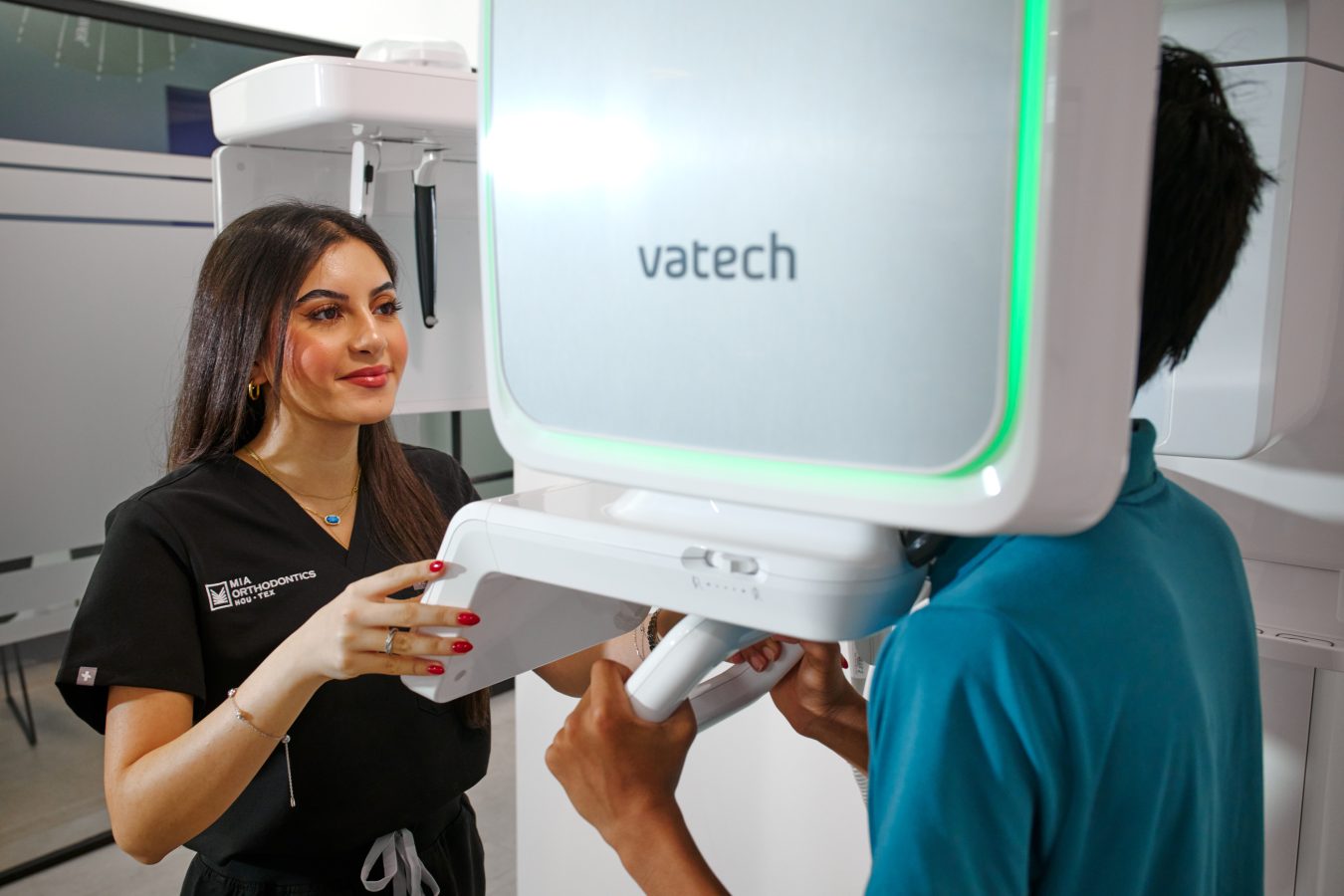
Planning starts with a detailed look at your teeth, jaw and bone. Mia Orthodontics uses a 4-in-1 digital 3D X-ray system with CBCT imaging, which helps map where there is enough bone and where roots sit. You can read more about the imaging technology used for planning.
2. Custom placement planning
Using digital tools, Dr. Hourfar maps the ideal placement for each mini-implant so the anchor sits exactly where support is needed.
3. Placement in the office
Placement is a quick, in-office procedure under local anesthesia. The practice compares the sensation to receiving a filling. Some pressure afterward is normal, and pain is typically minimal and manageable with over-the-counter care.
4. The active phase
Your braces or aligners are connected to the anchor to deliver targeted movement. Mini-implants usually stay in place for about 6 to 12 months, depending on how complex the treatment is.
5. Removal and retention
When the anchor has done its job, it is removed quickly and painlessly, typically with less discomfort than a routine cleaning. Treatment is then finished and protected with a retainer.
Who is a good candidate for mini-implant assisted orthodontics?
TADs are a tool for specific movements, not something every patient needs. You may be a candidate if you have:
- A deep bite caused by over-erupted molars
- A gummy smile or vertical asymmetry
- Spaces that need controlled closure
- A midline that needs repositioning
- A movement that braces or aligners can’t achieve on their own
Good candidates also have healthy gums and supporting tissue and are willing to keep the area clean during the short time the implant is in place. Adults often benefit because their jaws are no longer growing, and our adult braces page covers what treatment looks like later in life.
When a TAD is not the right answer
If gum health is poor, the gums need attention first. And if a bite problem comes from the size or position of the jaw itself, surgery or growth-guided treatment may be more appropriate. That is why 3D imaging comes before any decision.
Are there any risks or limits to mini-implants?
Mini-implants are a routine in-office procedure, but like any appliance they come with a few things to watch for. Knowing them ahead of time makes them easy to manage.
Loosening
Occasionally a mini-implant loosens before treatment is finished, most often when the gum around it is inflamed or it is disturbed repeatedly. If that happens, your orthodontist can reassess and, where needed, place it again or adjust the plan. That is one reason healthy gums are part of being a good candidate.
Gum irritation
The tissue around the head of the implant can get tender if plaque builds up. Gentle, consistent cleaning usually keeps it calm, and the area settles once the implant is removed.
They are a helper, not a shortcut
A TAD only works as part of a well-planned treatment. It doesn’t replace braces or aligners, and it can’t fix a problem that comes from the jaw itself.
How do you care for a mini-implant during treatment?
- Brush the area gently twice a day with a soft brush, as you would around a bracket.
- Rinse after meals so food doesn’t collect around the head of the implant.
- Avoid pressing on it with your tongue or fingers.
- Call the office if it feels loose or the gum around it stays sore.
Most patients report they barely notice a mini-implant once it is placed, because it is small, smooth and low profile.
Can mini-implants shorten treatment?
They can. Because force goes exactly where it is needed, there is less unwanted shifting to correct later, and many patients complete treatment faster. The practice notes that because mini-implants are placed directly where support is needed, many patients see improved results in months, not years. Patients focused on speed can also ask about accelerated orthodontics, which uses different tools to shorten treatment.
Mini-implant FAQs
Do mini-implants hurt?
Placement uses local anesthesia. Some pressure afterward is normal, but pain is minimal and usually managed with over-the-counter care.
Will people be able to see them?
They are small and discreet. Depending on location, most are hard to spot in conversation, and most patients say they barely notice them after placement.
Does insurance cover mini-implants?
Coverage varies by plan. The team helps verify your benefits and can set up flexible payment options, including interest-free monthly payments.
Can mini-implants be used with clear aligners?
Yes. Mini-implants support targeted tooth movement alongside braces or aligners, so choosing aligners doesn’t rule them out.
Find out if mini-implants fit your treatment plan
The only way to know whether a TAD would help is an exam with 3D imaging. Schedule a free consultation or call or text (281) 661-2789 to visit Mia Orthodontics in Houston.