
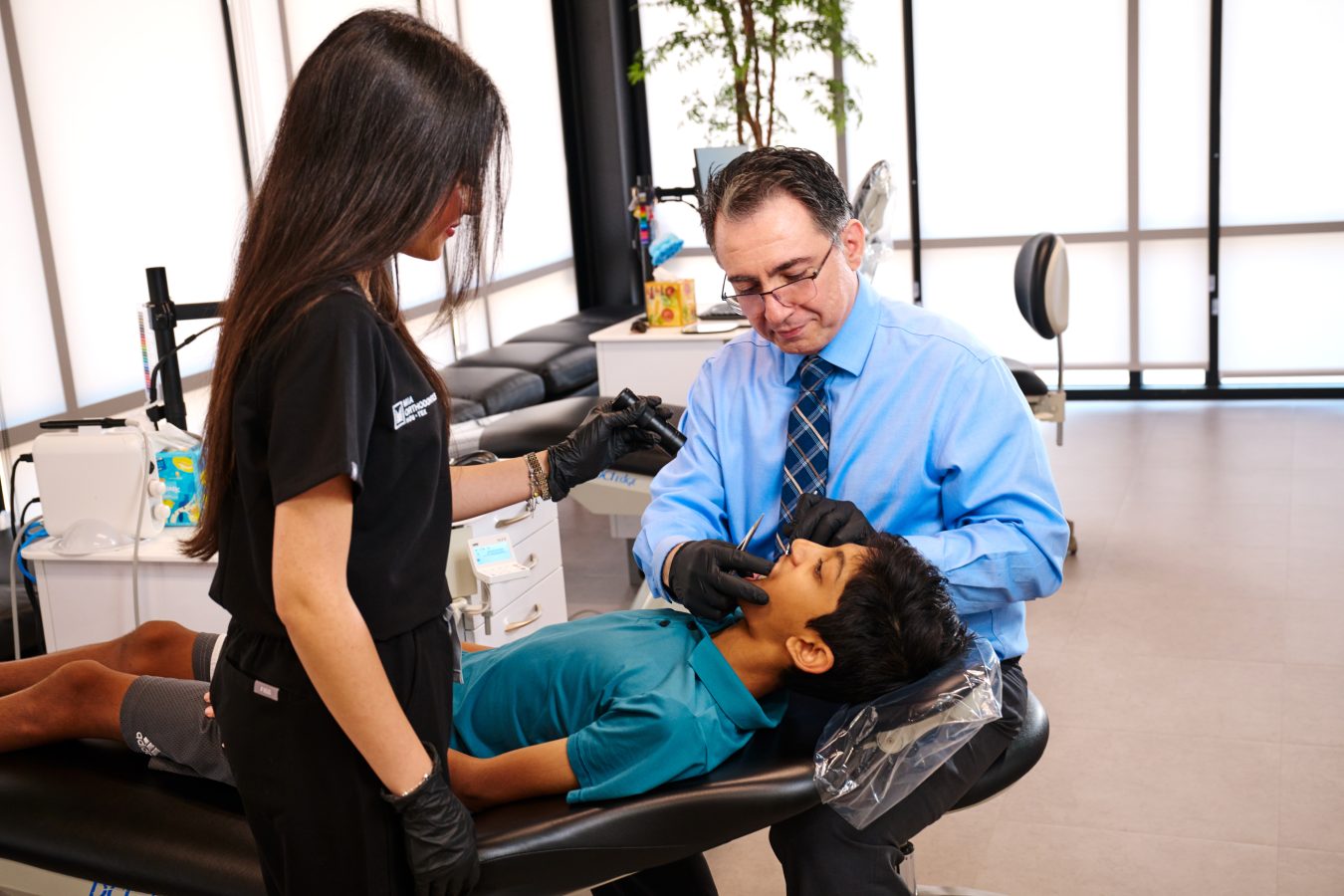
A crossbite is a bite problem where some upper teeth sit inside the lower teeth when you close, instead of slightly outside them. It can affect the front or back teeth, and it is usually corrected with an expander, braces or aligners.
What Is a Crossbite?
In a healthy bite, the upper teeth form a slightly wider arch than the lower teeth. When you bite down, the upper front teeth rest just in front of the lower front teeth and the upper back teeth overlap the outside edges of the lower back teeth. A crossbite flips that relationship for one or more teeth, so an upper tooth ends up tucked behind or inside its lower partner.
Some crossbites involve a single tooth and are easy to miss. Others involve a whole side of the mouth, and the jaw may slide to one side every time the teeth come together.
What Are the Different Types of Crossbite?
Orthodontists describe a crossbite by where it is and how far it reaches. An anterior crossbite involves the front teeth, where one or more upper incisors sit behind the lower incisors. It can look similar to an underbite, but it often involves only a tooth or two rather than the whole jaw.
A posterior crossbite involves the back teeth. On the MARPE page at Mia Orthodontics, it is described simply: the upper back teeth sit inside the lower teeth. A posterior crossbite can be unilateral, affecting one side, or bilateral, affecting both sides. A one-sided crossbite sometimes comes with a sideways shift of the lower jaw as it searches for a comfortable closing position.
The other key distinction is dental versus skeletal. A dental crossbite happens when individual teeth are tipped or positioned in the wrong place while the jaws themselves are a reasonable size. A skeletal crossbite happens when the upper jaw is too narrow for the lower jaw. The difference matters, because tipping teeth can fix a dental crossbite, while a skeletal one usually needs the upper jaw itself to be widened.
What Causes a Crossbite?
The most common underlying cause is a narrow upper jaw. When the upper arch is not wide enough to hold the teeth or to match the lower arch, the back teeth can fall inside the lower teeth and the remaining teeth can crowd together.
Habits and breathing patterns during childhood can play a part as well. Thumb sucking, tongue thrusting and long-term mouth breathing can all influence how the palate and jaws develop. The airway orthodontics page at Mia Orthodontics notes that underdeveloped jaws or narrow palates can restrict the airway in children, and that crowded teeth or narrow arches are among the signs worth an evaluation.
Other contributors include baby teeth that are lost too early or too late, adult teeth that erupt in the wrong position, and inherited jaw size and shape.
What Happens If a Crossbite Is Not Treated?
Crossbites rarely correct themselves once adult teeth are in place. Left alone, a crossbite can put uneven pressure on certain teeth, which may lead to worn enamel, chipped edges or teeth that are harder to keep clean. When the lower jaw shifts to one side to close, that repeated sideways movement can contribute to uneven jaw growth in children and strain on the jaw joints and muscles.
A skeletal crossbite caused by a narrow palate can also be linked to breathing concerns, since the floor of the nose and the roof of the mouth are connected. Not every crossbite affects breathing, but it is one of the reasons orthodontists ask about snoring, mouth breathing and sleep during an evaluation.
Timing also changes the options. In growing children, the upper jaw can usually be widened with a standard expander. By the late teens and adulthood, the seam down the middle of the palate has typically fused, so the same appliance tends to tip teeth outward instead of widening the bone. Treating earlier often means simpler treatment.
How Is a Crossbite Treated at Different Ages?
The right approach depends on the type of crossbite and how mature the jaw is. Here is a general comparison of the options described across the Mia Orthodontics website.
| Patient | Common approach | What it does |
|---|---|---|
| Growing children | Standard palatal expander, or the Invisalign Palatal Expander for some patients | Widens the upper jaw before the palate seam fuses |
| Teens and adults with a dental crossbite | Braces or clear aligners | Moves individual teeth into the correct position |
| Older teens and adults with a narrow upper jaw | MARPE, followed by braces or aligners | Widens the upper jaw itself using miniscrews in the palate bone |
| Adults whose needs go beyond MARPE | Surgically assisted expansion or jaw surgery | Repositions bone with an oral and maxillofacial surgeon |
For a single tipped tooth, braces in Houston or clear aligners may be all that is needed. For a narrow upper jaw, expansion usually comes first, then teeth are aligned once there is room. Your orthodontist will explain which category your bite falls into before recommending anything.
How Does MARPE Fix a Crossbite in Adults?
Adults with a skeletal crossbite were once told that jaw surgery was the main way to widen the upper jaw. MARPE, or miniscrew-assisted rapid palatal expansion, gives many older teens and adults another path. The expander is anchored directly to the bone of the palate with small titanium miniscrews, so it pushes against bone rather than relying only on the teeth. That steady pressure can gradually separate the two halves of the upper jaw at the midline.
At Mia Orthodontics, board-certified orthodontist Dr. Alireza Hourfar places the miniscrews and expander in the office with local anesthesia, and most patients describe the feeling as pressure rather than pain. The expander is then activated in small steps on a set schedule. A temporary gap often opens between the front teeth, which is a sign the bone is separating as planned. The appliance stays in place for several months while new bone fills the space. Braces or aligners then close the gap and finish the bite.
In some cases, Dr. Hourfar pairs MARPE with piezo-assisted corticotomies, a variation called MARPPE, depending on age, bone and the amount of expansion needed. When surgery truly is the right answer, the practice coordinates with oral and maxillofacial surgeons.
When Should a Child Be Checked for a Crossbite?
Mia Orthodontics offers orthodontic evaluations for children as young as 7, and a crossbite is one of the problems that early visit is designed to catch. At that age the jaw is still growing, so widening a narrow palate is often more straightforward than it will be later. Learn more about why early orthodontic care matters for kids.
Parents can watch for a few clues at home: the lower jaw sliding to one side when the child bites down, upper front teeth that sit behind the lower ones, crowding, or habits such as thumb sucking and mouth breathing. Snoring and restless sleep are also worth mentioning, and our post on signs your child may need an airway evaluation covers those in more detail.
Frequently Asked Questions
Can a crossbite fix itself?
Once the adult teeth have erupted, a crossbite generally does not correct itself. In young children, an orthodontist may monitor a minor crossbite for a short time, but a skeletal crossbite caused by a narrow upper jaw usually needs treatment to widen the jaw.
Is a crossbite the same as an underbite?
Not exactly. An underbite usually means the whole lower jaw and front teeth sit ahead of the upper teeth. An anterior crossbite can involve just one or two front teeth. A posterior crossbite affects the back teeth and is a different problem entirely.
Can clear aligners fix a crossbite?
Aligners can correct many dental crossbites, where the problem is the position of individual teeth. When the upper jaw itself is too narrow, expansion is usually needed first, and aligners or braces can then finish the bite.
How is a crossbite diagnosed?
Diagnosis starts with an exam of how the teeth meet and how the jaw moves. Mia Orthodontics uses a 4-in-1 digital 3D X-ray system that includes CBCT, along with an intra-oral scanner, to measure the jaws and see whether a crossbite is dental or skeletal. See the technology we use for more.
Book a Crossbite Evaluation in Houston
If you or your child has a bite that shifts to one side or upper teeth that sit inside the lower teeth, a visit with Dr. Hourfar will show whether the problem is dental or skeletal and what treatment makes sense at your age. Schedule a free consult at Mia Orthodontics at our office at 3636 Greenbriar Dr., Ste A-101, or call or text (281) 661-2789.