
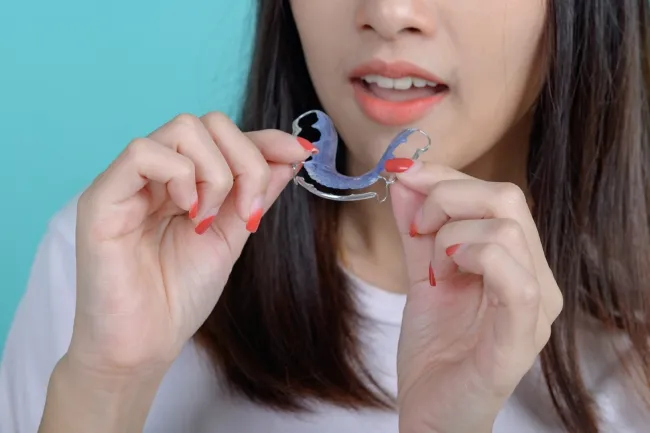
Retainer wear after braces or clear aligners follows a predictable arc: full-time for the first few months, then nights only for a year or two, then a few nights per week for life. How long you actually need to wear a retainer after braces or clear aligners depends on your original bite, your age, and how stable your results are at each check.
What Is a Retainer and Why Is It Required After Treatment?
A retainer is a custom appliance that holds your teeth in their new position after active treatment ends. Bone, gum tissue, and the periodontal ligaments around each tooth need roughly 6 to 12 months to firm up around the corrected positions. Retainers hold everything steady while that remodeling finishes.
Skip retention, and shifting can start fast. Teeth carry a kind of memory, and the ligaments that were stretched during treatment want to pull them back toward where they started. Relapse often begins within weeks, not years.
At MIA Orthodontics, we treat retention as a permanent phase of care rather than an optional add-on. Your treatment doesn’t end the day your braces come off or your last aligner comes out. Retention keeps that new alignment steady while the tissue around every tooth finishes settling.
The same rules apply whether you finished with braces or clear aligners. The method that transformed your smile doesn’t change the biology of how teeth settle afterward.
How Long You Actually Wear a Retainer After Braces or Clear Aligners: A Realistic Timeline
Most patients wear a retainer full-time (20 to 22 hours a day) for the first 3 to 6 months, then switch to nights only for the next 12 to 24 months. After that, wearing your retainer 3 to 7 nights per week indefinitely is the current standard for keeping lasting results. That arc holds whether you finished in braces or in clear aligners like Invisalign.
Here’s how the phases typically break down:
- Months 0-6: Full-time wear. You’ll wear your removable retainer 20 to 22 hours a day, removing it only to eat, drink anything other than water, and brush. This is the highest-risk window for relapse.
- Months 6-24: Nights only. Once your tissues have stabilized, most patients drop to sleeping in their retainer every night. Same protection, far less hassle.
- Year 2 and beyond: 3 to 7 nights per week, indefinitely. Teeth drift naturally with age, even in people who never had braces. A few nights a week keeps everything where it belongs.
- Fixed retainers: 5 to 10+ years. A bonded wire behind the front teeth often stays in place well past a decade, as long as the bond holds and your hygiene is good.
Your schedule isn’t one-size-fits-all. Dr. Hourfar, a board-certified orthodontist, adjusts it based on how your teeth started, how far they moved, and how stable they look at each retention check.
If your bite required significant correction, expect a longer full-time phase. If your case was mild, you may move to nights-only sooner. The plan gets built around you, not a calendar template.
Why Is Consistent Retainer Wear Important?
Wearing your retainer on schedule is a straightforward habit. A few minutes a night protects everything you spent months or years earning.
What Does Consistent Retainer Wear Protect?
Steady wear keeps the alignment you already earned from quietly slipping away, and it spares you the time and expense of doing the same work a second time.
- Protects your investment. Months of visits, adjustments, and aligner changes stay locked in.
- Prevents lower front crowding. The lower incisors are the first teeth to rotate and overlap when retention lapses. It’s by far the most common relapse pattern.
- Avoids retreatment. Refinement aligners or a second round of braces cost real time and money. Retainers cost far less.
How Does Retention Affect Your Bite Over Time?
Retention does more than keep your front teeth looking tidy. It also protects the way your upper and lower teeth meet, which is a big part of what makes lasting results comfortable to live with year after year.
- Maintains your bite. Even small shifts change how your teeth meet, which affects chewing comfort and jaw function over time.
- Adds a layer of enamel protection. For patients with mild nighttime grinding, a retainer can buffer some of that wear.
Fixed vs. Removable Retainers: Which Keeps Teeth Straighter?
Neither type wins outright. Fixed retainers never get forgotten, but removable retainers cover more teeth and are easier to keep clean. What actually predicts long-term stability is whether you wear it, not which one you choose.
| Retainer Type | How It Works | Pros | Watch Out For | Typical Lifespan |
|---|---|---|---|---|
| Bonded (fixed) wire | Thin wire cemented behind the front teeth | Always working, completely invisible, zero compliance needed | Requires threading floss daily; bond can fail without you noticing | 5-10+ years |
| Clear plastic (Essix, Vivera) | Custom vacuum-formed tray over the full arch | Discreet, comfortable, holds every tooth | Easy to lose; warps in heat (car dashboards, hot water, dishwashers) | 1-3 years |
| Hawley | Acrylic plate with a visible metal wire across the front | Durable, adjustable, repairable | More noticeable; slight speech adjustment at first | 5+ years |
Plenty of patients end up with a combination: a bonded wire on the lower front teeth paired with a clear retainer on top. You get the reliability of fixed retention where relapse is most likely, plus full-arch coverage above.
One caution with bonded wires. If a section debonds and you don’t notice, those teeth can drift while the rest stay put. That’s a good reason to keep periodic retention checks on your radar even years out.
The honest takeaway: the best retainer is the one you’ll actually use. Compliance beats material every single time.
What Affects Retainer Cost, Replacement and Longevity
Retainer cost depends on the type you choose, whether you need one arch or two, the material, and whether spare sets are bundled in. Clear retainers generally last 1 to 3 years before they need replacing. Hawley retainers often last 5 or more. Fixed wires last the longest but may need repair if the bond fails.
Broadly speaking, clear trays sit at the lower end of the range, Hawley retainers in the middle, and bonded wires at the higher end because of the chair time involved in placing them.
A few things worth knowing before you’re standing in the office asking questions:
- Ask what your plan includes. Many personalized care plans cover the first set of retainers as part of treatment. Confirm this early rather than assuming.
- Order spares upfront. Buying a second set while your final scan is still on file usually costs less than an emergency replacement that requires a new impression and rush fabrication.
- Replace lost retainers fast. Teeth start drifting within days of stopping wear. A replacement retainer runs a small fraction of what a second round of treatment would.
- Heat kills clear retainers. Hot water, car dashboards, and dishwashers warp the plastic permanently. Most premature replacements trace back to heat, not normal wear.
- Fixed wire repairs vary. Rebonding a single loose spot is a quick visit. Replacing the whole wire takes more chair time.
At MIA Orthodontics, we lay out the financial details clearly, including low monthly payment plans and an online payment calculator, so retention costs don’t catch you off guard after treatment wraps up.
Who Needs Longer or Full-Time Retention?
Some cases carry a higher relapse risk and call for extended or full-time retention well past the standard timeline. Your original bite is the biggest clue.
You may need a longer retention phase if any of these apply:
- Severe crowding or heavily rotated teeth. Rotations are the most relapse-prone correction in orthodontics. The fibers around those teeth hold tension for years.
- Closed extraction spaces. Spaces that were closed during treatment can reopen slightly without steady retention.
- Large gaps, deep bites, or expanded arches. Big corrections mean more tissue adaptation and a longer stabilization window.
- Adult treatment. Bone remodels more slowly with age, so many adults benefit from a longer full-time phase before dropping to nights only.
- Tongue thrust, mouth breathing, or airway concerns. Ongoing muscular forces can push teeth back out of position regardless of how well treatment went. This is where airway-focused care matters, because addressing the underlying cause protects the result.
- Growing teens. Jaws keep developing and wisdom teeth arrive, so periodic monitoring through the late teens is smart.
A retention check visit sorts this out. We look at how your teeth are holding, compare against your finish records, and set a schedule that fits your actual risk rather than a generic rule.
Frequently Asked Questions About Retainers
Do I have to wear a retainer forever?
For most patients, yes, in the sense that nightly or few-nights-weekly wear is recommended indefinitely. Teeth shift throughout adult life whether or not you had orthodontic treatment. The good news is that lifelong retention means a few hours of sleep with a thin appliance in, not full-time wear forever.
What happens if I stop wearing my retainer?
Teeth can begin shifting within weeks to a few months, with the lower front teeth usually moving first. Early shifts are subtle and easy to miss until the retainer suddenly doesn’t fit. If you’ve stopped, get back in touch before assuming your old retainer will still seat properly.
My retainer feels tight. Is that normal?
Mild tightness after a few nights off is common and usually resolves within a night or two of consistent wear. Real discomfort, sharp pressure, or a retainer that won’t fully seat is a different story. Don’t force it. Have it evaluated instead, because forcing an ill-fitting retainer can damage teeth or the appliance.
Can I use my old retainer if my teeth have already shifted?
Only if the movement is very minor and the retainer still seats without force. Retainers are designed to hold position, not to apply the staged forces needed to guide teeth back into alignment. If it doesn’t fit easily, bring it in so we can check whether a new retainer or a short refinement is the better path forward.
How do I clean my retainer?
Rinse it in cool water every time you take it out, then brush it gently with a soft toothbrush and a drop of mild soap. Retainer cleaning tablets work well for a deeper clean once or twice a week. Never use hot water, boiling water, a dishwasher, or your car’s cupholder in a hot climate, since heat warps the plastic permanently.
Can I wear a retainer instead of clear aligners?
No. Retainers hold teeth where they already are, while clear aligners apply staged, calculated forces to move teeth into new positions. They’re built for completely different jobs. If your teeth have shifted enough to bother you, a short course of aligners followed by fresh retainers is the usual answer.
Keeping Your Results for the Long Haul
Retention is the quiet half of orthodontics. It doesn’t get the before-and-after photos, but it’s what makes those photos still accurate ten years later.
If your retainer no longer fits, has gone missing, or you’re simply not sure how often you should be wearing it, a retention check is a straightforward way to find out where you stand. Led by Dr. Hourfar, a board-certified orthodontist, our office builds retention schedules around your specific case, not a generic timeline, with whole-patient care and airway-focused care factored in.
Protecting the results you worked for starts with a clear plan. Explore your options with a free consult at MIA Orthodontics.
More on what comes after treatment: retainers in Houston, plus our pages on braces and clear aligners.